A burning oil smell but no leak visible on the driveway can still point to an external oil leak. Oil may collect on an undertray or reach hot engine or exhaust components before it reaches the ground, while spilled oil after servicing is another possibility. A persistent smell needs inspection, especially if you notice smoke, falling oil levels, or a warning light.
As November mornings turn colder, you may first notice an unfamiliar smell while using the heater or defroster. Tell the technician the smell appeared with heater use, without assuming the heater is its source.
A Burning Oil Smell With No Visible Leak
An oil leak does not have to leave a puddle beneath a parked car. Its route, size, and location affect where the oil ends up. A small leak higher on the engine may travel across components before reaching a hot surface. Oil can also remain on shields or an undertray, hiding evidence that would otherwise appear on the driveway.
Some leaks become more noticeable while the engine is running or after a drive. A clean parking spot therefore cannot rule out a problem that needs attention.
The useful distinction is between “I cannot see a leak” and “an inspection found no external leak.” The first describes an observation. The second requires examining areas that may be difficult to see from above.
Where an External Oil Leak May Begin
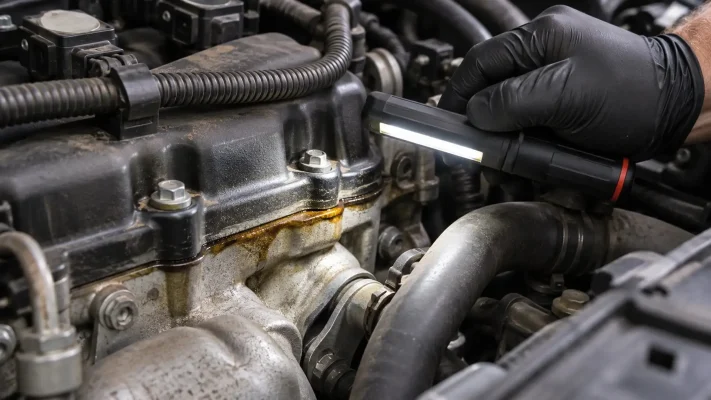
An external oil leak can originate at a gasket, seal, oil filter housing, or another oil-carrying connection. The source needs to be traced rather than inferred from the lowest oily patch. The AA identifies cam-cover gaskets, sump gaskets, oil filters, and engine seals among possible leak sources. Different engines use different arrangements, so a familiar part name does not establish the diagnosis for your vehicle.
A valve-cover or cam-cover gasket leak can leave residue high on the engine. A leak near the filter housing can spread along adjacent surfaces. Oil found near the bottom may have travelled from somewhere above it. Ask how the technician traced the oil back to its starting point. Replacing the component nearest a visible drip can miss the actual source and leave the smell unchanged.
Sil’s vehicle diagnostic services are an appropriate starting point for an unexplained smell that returns after driving.
An External Leak Versus Oil Burning Inside the Engine
Oil reaching a hot surface outside the engine is different from oil entering the combustion process. Both can involve oil loss, but they require different investigations. An external leak may produce residue or smoke in the engine compartment. Oil entering the combustion chambers may contribute to blue-grey exhaust smoke and measurable consumption, although a lack of obvious smoke does not settle the question.
Normal cold-weather exhaust condensation can create a visible white plume that disperses. It should not be used to explain away persistent smoke, a strong smell, or falling fluid levels. The location, duration, and associated symptoms matter more than a quick judgement about colour.
| Observation | What It Can Help Investigate |
| Smell strongest after parking a warm vehicle | Residue or leakage near hot components |
| Oil on an undertray without a driveway stain | An external leak concealed by a panel |
| Falling oil level without an obvious external source | A concealed leak or oil consumption |
| Persistent smoke from the tailpipe | A combustion or fluid-related issue requiring assessment |
| Smell beginning immediately after servicing | Spillage or a service-area leak that needs checking |
These clues help direct inspection. None identifies a failed part on its own.
Why the Smell May Enter Through the Vents
A smell entering through the vents can originate outside the cabin. The ventilation intake may draw in odours from the surrounding area, including the engine compartment. During November heater and defroster use, pay attention to when the smell appears. Note whether it occurs while stopped, after a longer drive, or with a particular ventilation setting. Report the pattern instead of repeatedly testing it in traffic.
Changing to recirculation may alter what you notice, but it does not fix the source or prove the cabin is safe. An odour described as burning oil can also be confused with overheated electrical insulation, rubber, brakes, or another fluid. If you suspect exhaust or fuel fumes, stop safely and arrange help. Carbon monoxide itself has no smell, so an absence of odour cannot establish that an exhaust-related problem is harmless.
What if the Smell Started After an Oil Change?
Residual oil spilled during service can produce an odour when nearby surfaces heat up, but a new smell should still be reported to the servicing shop. Do not assume every post-service smell is harmless residue. The filter, its seal or housing, the drain plug, and the oil level may need checking. The shop can distinguish an active leak from an area that needs cleaning and reassessment.
Provide the service date, the distance driven since the appointment, and whether the smell is weakening or becoming stronger. Do not wait for an arbitrary number of kilometres if smoke, fresh leakage, or a warning appears.
Sil’s oil and filter service supports routine maintenance, but an oil change alone is not a repair for a leaking gasket or seal. Mention the smell when booking rather than requesting only a standard oil change.
When to Stop Driving and Arrange Help
Stop safely and switch off the engine if the oil-pressure warning appears while it is running, or if there is heavy smoke, suspected fire, or significant leakage. Continuing to drive can turn an unresolved symptom into engine damage or a safety emergency. If you suspect fire, leave the vehicle, move away, and call emergency services. Do not open the bonnet to investigate a suspected engine fire.
Oil pressure and oil level are related but different. A normal level does not prove that the engine has adequate pressure, and adding oil does not automatically resolve a pressure warning. Manufacturer guidance specifically warns against continuing to run the engine with a persistent pressure warning even when the level is correct. Sil’s information on dashboard warning diagnostics covers oil warnings among the concerns that need assessment.
If it is safe to check the level, follow the owner’s manual for parking, waiting time, and measurement. Keep clear of hot parts and moving components. Some vehicles use an electronic measurement procedure rather than a dipstick. Never crawl under a vehicle supported only by its emergency jack. Avoid touching residue to identify it while the engine compartment is hot.
How a Technician Finds the Source
A technician first needs to distinguish the suspected fluid and locate its source. Cleaning an affected area and checking for fresh leakage may be necessary when old residue obscures the path. Depending on the engine and symptoms, inspection may require removing an undertray, examining the engine from below, or using an appropriate leak-detection dye. Further testing may be needed if oil consumption is suspected instead of an external leak.
A useful repair recommendation should explain where the oil originates, what evidence supports that finding, and what work is required. After repair, cleaning and rechecking help distinguish remaining residue from continuing leakage.
Before your next winter commute from Clarkson or southeast Oakville, arrange an assessment for a recurring burning smell. Tell Sil’s Auto Care Centre when it happens, whether the level has changed, and whether any recent service preceded it. Include any smoke, warning messages, or recent top-ups when you call.
Frequently Asked Questions
Will a cabin air filter replacement fix a burning oil smell?
A cabin air filter replacement does not repair an engine oil leak. If the filter has absorbed an odour, any decision to replace it should accompany investigation of the original source.
Can I use a stop-leak additive instead of repairing the leak?
A stop-leak additive is not a substitute for identifying why oil is escaping. Ask whether any proposed product is approved for your engine and how it would address the confirmed fault before adding it.
Will an engine flush remove the smell?
An engine flush does not repair an external gasket or seal leak. Flushing should only be considered for a separate, justified maintenance reason that is appropriate for the engine.
Can I identify the source by where the oil lands on cardboard?
Cardboard can help document drips beneath a safely parked vehicle, but it cannot reliably identify the source. Oil may travel across components before falling, so share the observation with the technician rather than using it to choose a replacement part.